Take a Virtual Tour of the Small Craft Simulator
Fast Rescue Craft Simulation Training
Royal Canadian Marine Search and Rescue has a comprehensive training program for its rescue crews, the cornerstone of this program being the world´s first accurate simulator for Fast Response Craft (FRC). RCM-SAR continues to develop this technology, and here describes its present status.
Program Updates:
The simulator runs with the latest simulator software from Transas. This software gives a very clear picture of the simulated areas, including realistic seas and vessels represented which exist in real life. Included in the software is a special Search and Rescue module, including the ability to fire flares, AIS, Radio Direction Finding, searchlights, broken down vessels, life rafts, MOBs, SARTs, and our very own Search and Rescue Vessel Model to operate.
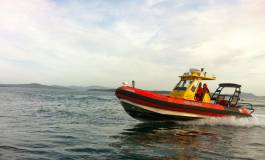
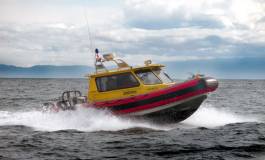
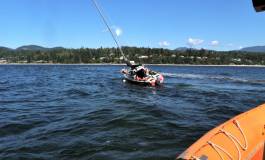
In addition there is also a Titan 249 Pilot, fitted out to match the simulator, to train on the water as a follow up to work in the simulator.
After some serious thought and to welcome the new changes, the training structure for all members have been updated as well. Essentially there are now 2 four day courses, allowing allowed us to develop many areas of skills and knowledge, making the training as comprehensive as possible.
...the course was at least as valuable as RHIOT school, and possibly more so. I never realized how much more there was to learn
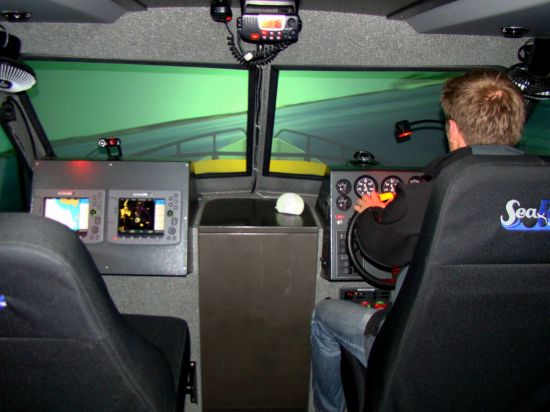
This immersive simulator includes: an accurate mathematical modeling of vessel motion and a mock-up of an actual FRC cabin, complete with real vessel controls and equipment for a truly realistic experience. Also, detailed graphical models of the vessel and target vessels operate in a representation of many different exercise area including Victoria to Sidney, Vancouver and Broken Islands ocean environment. These areas include accurate depths, buoys, lights, and charted information. A 270 degree surround projection system displays the environment, and environmental parameters are controlled by the instructor. Completing the immersive experience is a 5 speaker sound system providing simulated engine and environmental noise.
1. The SARnav-1 Course (Small Vessel Operators Proficiency for Crew Operations) was designed for Coast Guard and RCM-SAR crew members who have been members for 10 months, as well as personnel from outside agencies and SAR partners. The course focuses on basic and practical navigation skills in a 3-person crew dynamic on board fast response craft. Participants are awarded an RCM-SAR SARnav-1 certificate as well as a Transport Canada SVOP certificate upon successful completion.
2. The SAR Nav-2 Course (Practical Pilotage Techniques for Reduced Visibility), is reserved for Advanced Crew and Coxswains who have attended SAR Nav-1 or the original SAR Nav Course. The purpose of the course is to develop the necessary skills to safely navigate the vessel in restricted visibility. The course also includes small vessel crew management, positive control and how to maintain situational awareness using charts, RADAR, and electronic charting tools. On successful completion of the course, participants will receive both a Transport Canada SEN-L Certificate, in addition to an RCM-SAR SAR Nav.2 Certificate.
Please visit the following links to learn more:
 SARnav 1 Course Description
***Please see bottom of Page for Course Dates
RCM-SAR Simulator Video



Simulator Program Background
Royal Canadian Marine Search and Rescue (RCM-SAR) has evolved during the past few years into an organization that delivers search and rescue (SAR) consistently across the entire British Columbia coast. RCM-SAR Stations in partnership with their communities have purchased fast search and rescue craft and now offer 24/7/365 on call service in most areas.These rescue vessels arrive on the rescue scene quickly and prevent immediate loss of life through scene stabilization and person recovery. With the use of larger and faster vessels, the need for modern and aggressive training approaches grew with the increasing risk level. RCM-SAR vessels operate in adverse conditions and the level of difficulty of a restricted visibility or night transit increases exponentially with the speed of the vessels.
The RCM-SAR rescue craft simulator fits into the operational SAR training program. Funded largely through the New SAR Initiatives Fund the project was initially proposed 2003. Since corporate donations (including a complete vessel cabin from Titan Boats), and hundreds of hours of volunteer time brought the project to reality in 2008.

Primary Training Objectives
Every time I stepped into the sim I learnt something new
- Decrease the risk of a catastrophic accident onboard RCM-SAR high speed rescue craft by:
- A web based radar and navigation simulator will be employed to develop the primary skills sets involved in operating electronic navigation equipment, passage planning and collision avoidance
- Employing a full mission simulator to evaluate and further refine positive vessel control by the whole crew in scenarios involving passage planning and collision avoidance
- Improve the performance of search and rescue crew communications and resource management during the execution of missions
- Develop training using scenarios with some higher risk and more complex SAR operations.
- Evaluate whole crew performance in the execution of large and small scale search operations in a full mission simulator

Current Project Status
Since the delivery of the simulator to Victoria, British Columbia in September 2007, RCM-SAR has provided many SARnav courses, giving advanced training to members of the RCM-SAR,Vancouver Police Marine Squad, Environmental Response, Environment Canada and the Canadian Boarder and Services Agency using the RASAR Small Craft Simulator. The reviews from course participants have been overwhelmingly positive.
Full Mission Bridge Simulation (FMS)
The full visual motion small vessel simulator of RCM-SAR allows them to augment their rescue vessel crew´s performance training. By putting the virtual vessel in precarious situations, whole crew dynamics and communications as well as the individual skills involved in each role can be evaluated. Here whole crews can evaluate and develop their integrated performance as a rescue vessel. The navigation station, helm and communication consoles reflects the typical configuration. The simulator is effective in bringing together many hours of crew and individual training to test complex skill interactions in the following areas:- Positive Vessel Control
- Crew Communications
- Conflict Management
- Coaching and Leadership
- Rescue Vessel Radio Communications
- Coastal Passage Planning and Passage execution
- Navigation and pilotage in visibility (Night/Day)
- Navigation and pilotage conning in reduced visibility (Night/Day)
- Collision Avoidance
- Searching in open water
- Vessel Emergency Procedures
- Incident Scene Assessment

Simulator Course Training Vessel - The Brewin
Simulator Course Dates
2017-2018
- 2017
- April 7 - April 11 FULL
- May 5 - May 9 FULL
- June 9 - June 13 FULL
- July 7 - July 11 FULL
- 2017
- April 21 - April 25 FULL
- May 26 - May 30 FULL
SARnav-1 (SVOP):
SARnav-2 (SEN-L):
SARcom (ROC-m):
TBA
Updated Feb 17, 2017
Small Craft Simulator Instructors
Francois Michaud - RCM-SAR Trainer OfficerDennis Chopko- RCM-SAR 34